 To All Posts
Fine, number-maxxers. We added the score.

I like numbers more than most people (as the "analytics" guy at Meta), yet I was always wary of patent quality scores, i.e., how good is this patent from 0-100? There's always a heated debate when discussing whether to introduce these to the team.
The problem is that "quality" means different things at different times to different companies. What's high quality to one company can be low to another. And a single number encodes numerous assumptions, and any two people reading the number will assume different things.
Then, the questions start: how was it calculated? But have you considered X? What about [near-impossible event Y]? If you proffer a single number and it doesn't fit their model of the world, they stop trusting it. At that point the score becomes counterproductive: it requires folks to process and filter out one more thing.
Last year, we shipped quality scores for patents, mostly based on forward citations. We pulled it. After watching AI work, I believe those “old-school” scores built on proxy signals, on balance, add more noise than they remove. There's a better way now to determine certain aspects of quality (like reads on competitors). Generate a claim chart. Run a light evidence of use mapping.
Other aspects can be comprehensively analyzed as well using AI. Today, a lawyer asks: "Does this score consider...." Analytics Guy: "Yes." These cost more than a forward citation calculation, but the signal is dramatically higher.
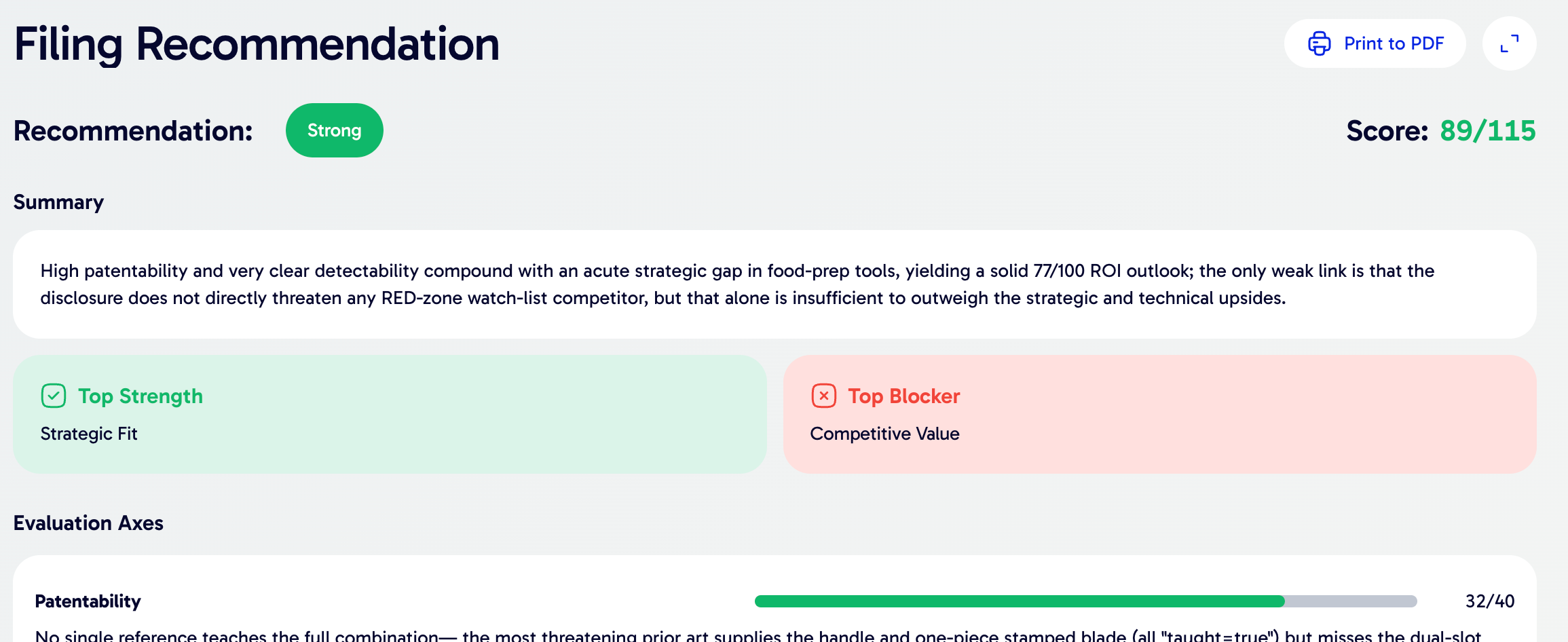
So we just added another score: filing recommendations.
We don’t show you the number alone. We break it down into individual axes, and the AI explains its reasoning on each. It's more believable because it comes with nuance instead of asking you to trust a black box. And, probably most importantly, you can fully customize the instructions for every axis based on your organization and your priorities.
So fine, number-maxxers. We added the score. But we made it explain itself first.
Subscribe to our newsletter
Get the latest insights on IP strategy and patent portfolio management, straight to your inbox.
Power Every Patent Decision
With One Platform
See how ArcPrime connects your portfolio, workflows, and business context to help your team make better decisions across the patent lifecycle.
