To All Posts
How to Automate Patent Status Tracking Across the USPTO and Foreign Registers

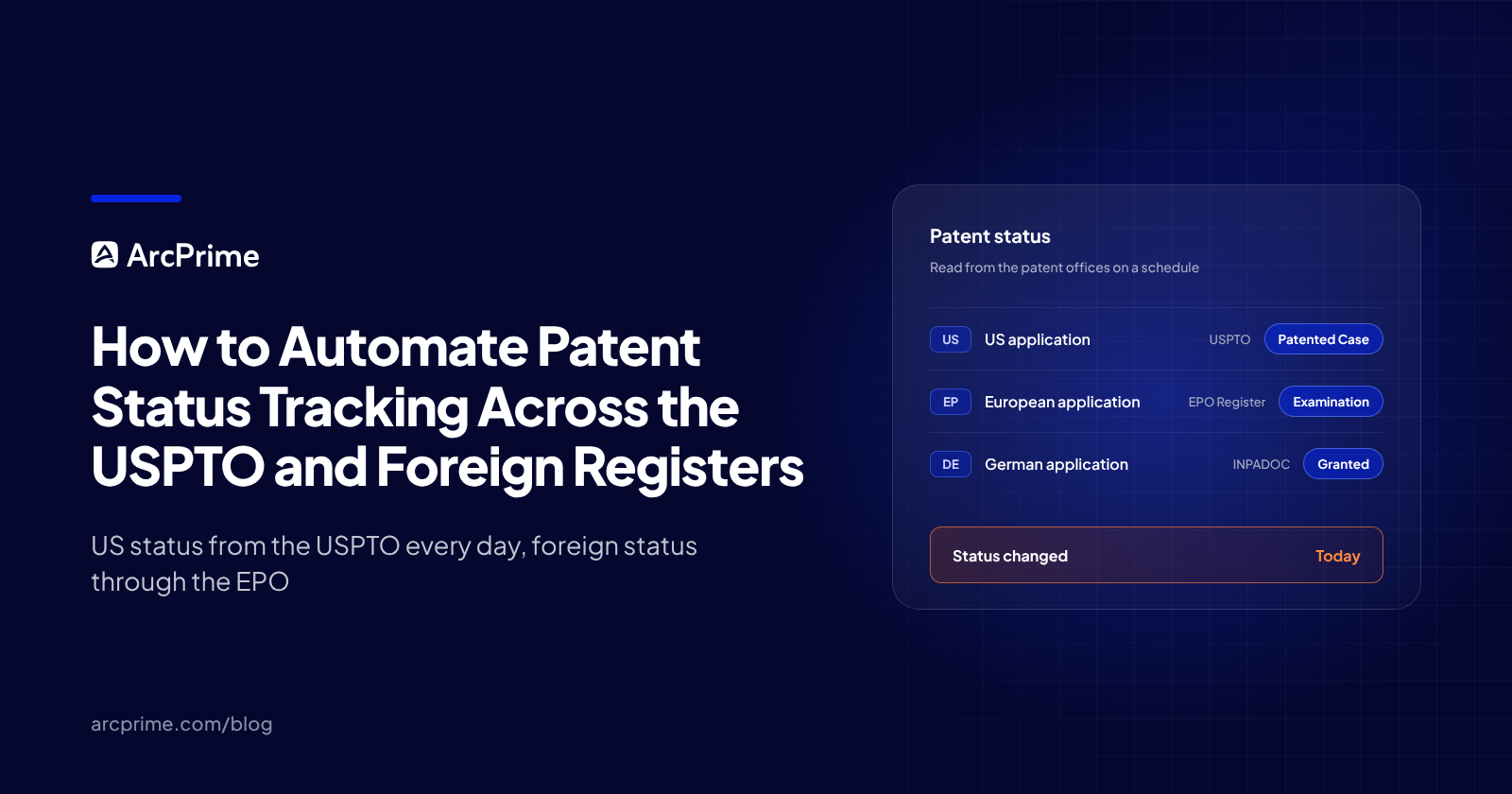
News that a patent issued often reaches you in an email from outside counsel or in the Issue Notification, and until your docket records the grant, the matter still reads pending. Any report you pull from the docket in the meantime counts that patent as unissued. Across a portfolio with family members in several countries, keeping status current by hand turns into a steady run of register lookups that cost time and call for no judgment at all.
Status is a natural first job to hand to automation. Software can automate patent status tracking without making any of the decisions that follow a status change.
The patent offices already publish the status you track
The USPTO publishes the status of US applications through its Patent File Wrapper API on the Open Data Portal and refreshes that data every day. Along with the USPTO's own status wording, such as Patented Case or one of its abandonment statuses, you get the application's bibliographic data, transaction history, continuity and assignment records. The data is free, and access takes an API key tied to a USPTO.gov account verified through ID.me.
For Europe, the EPO's Open Patent Services serves status from the free European Patent Register and the INPADOC legal status data you see in Espacenet. With a registered account, Open Patent Services is free up to a weekly data limit. Your docket can show a European application moving through examination, or a granted European patent going into opposition, when the Register or INPADOC records the change. Family members filed with the national offices that report to INPADOC come in through the same source, without a separate lookup at each office.
WIPO's PATENTSCOPE publishes international PCT applications in full text on their publication day, so you can confirm a family's PCT publication straight from WIPO. WIPO charges an annual subscription for automated access through the PATENTSCOPE web service.
Status updates land on the matter and family already in your docket
To automate patent status tracking, a status check reads each source on a set schedule and matches every record it returns to the matter and patent family already in your docket before it writes the new status to that matter. On the US side, a daily check of the USPTO record follows a matter from a pending application to a grant or an abandonment.
The match only works if your docket already holds a clean record of each matter, so if you are moving over from another system, that baseline comes first. This guide to switching IP management systems walks through how to build it.
A daily read of the USPTO record keeps up with faster grants
Since May 13, 2025, the USPTO has issued patents about two weeks after the Issue Notification, down from about three. The USPTO also notes that if you are not enrolled in its e-Office Action program, a patent may issue before the Issue Notification reaches you. A docket that reads the USPTO record daily can show that grant before the notice shows up.
Foreign status reaches your docket later through INPADOC
Status for family members filed at national offices reaches your docket secondhand, through the INPADOC legal status data those offices send to the EPO. According to Espacenet's guidance, the delay in that data varies by country and by the period covered, so a foreign family member can show an older status than the national office has on record. When a decision turns on a foreign matter's status, Espacenet recommends confirming that status directly with the national office.
ArcPrime builds status tracking into the docket
ArcPrime is an AI native IP management and docketing system. Case statuses update automatically from USPTO records, and status for foreign family members refreshes from worldwide patent legal event data. When those same USPTO records show a response, an RCE or an allowance, ArcPrime closes the matching office action task too. Patent Docketing Software for USPTO Extensions of Time covers how those tasks move and close.
When the USPTO, outside counsel and your internal records disagree, ArcPrime flags the difference for someone on your team to resolve.
Book a demo to see ArcPrime in action.
Frequently Asked Questions
Does the USPTO offer a free way to track patent status automatically?
Yes. The Patent File Wrapper API on the USPTO's Open Data Portal is free and updates every day. You need an API key tied to a USPTO.gov account verified through ID.me, and with that key your docket can read the USPTO's status record on a daily schedule.
Can foreign patent status be tracked the same way as US status?
Yes, through sources other than the USPTO. The EPO's Register holds status for European applications, and status from national offices reaches your docket through the INPADOC legal status data those offices supply to the EPO.
Is automated status data from every patent office always accurate?
US status in the Patent File Wrapper API is the USPTO's own record. Status from other offices comes through INPADOC on delivery timelines that differ by country, so Espacenet advises confirming a foreign matter's status with the national office that handles it.
Does automating status tracking remove the need for a paralegal to review the docket?
Automation takes over the routine register lookups and the entry of each status change a patent office posts. Someone on your team still settles the matters where sources disagree on status, and ArcPrime brings those matters to that person's attention.
Subscribe to our newsletter
Get the latest insights on IP strategy and patent portfolio management, straight to your inbox.
Power Every Patent Decision
With One Platform
See how ArcPrime connects your portfolio, workflows, and business context to help your team make better decisions across the patent lifecycle.