To All Posts
Patent Invoice Review: UTBMS Codes and USPTO Refunds

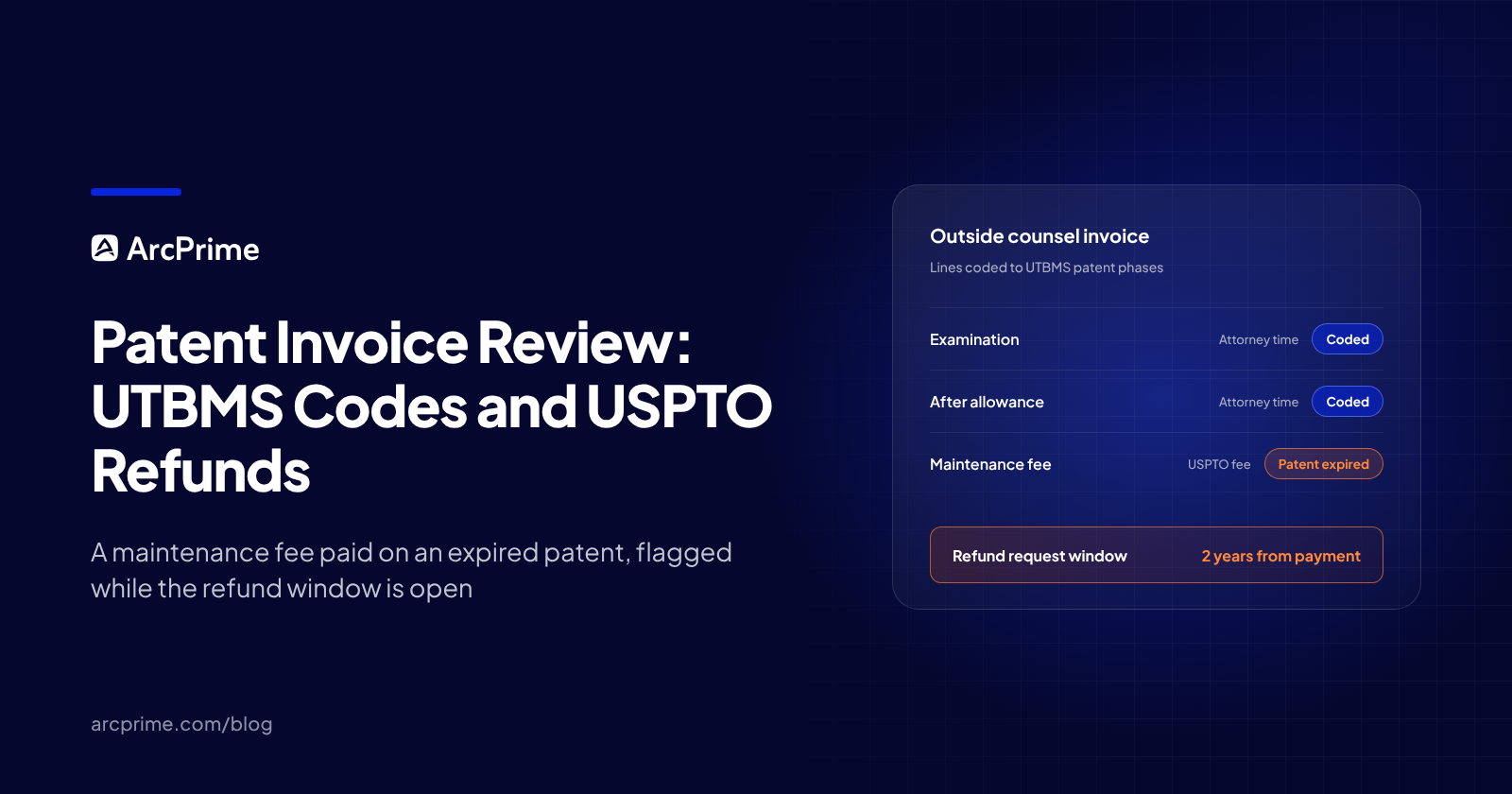
A USPTO fee that outside counsel paid in error, such as a maintenance fee on a patent that had already expired, can first reach you during patent invoice review. The USPTO may refund a fee paid by mistake or in excess of what was required, as long as you ask within two years of the day it was paid. If the firm bills that fee in a later period, the time before the invoice arrives has already come out of those two years. The patent's status on the day the fee was paid is in your docket, while the fee line is in your ebilling system.
Invoices for patent work can also carry UTBMS patent prosecution codes, which tell you the phase of the work behind each line.
The refund window starts the day the fee is paid
The USPTO's refund rule allows no extension of those two years, so the payment date on each government fee line tells you how much of the window is left when the invoice reaches you. The USPTO's examining manual counts a fee paid when no fee is required as a fee paid by mistake, which the refund rule lets the USPTO return. Maintenance fees can be refunded only under that rule and the small entity rule. The manual also says that a maintenance fee that was due and payable on the patent cannot be refunded.
UTBMS patent codes sort the work by phase
In April 2023 the LEDES Oversight Committee ratified the "110" Patent Prosecution Codes as part of UTBMS. The ratified set groups patent prosecution work into phases and breaks each phase into deliverable codes. In June 2024 the committee reported traction for the codes, with ebilling vendors and law departments moving ahead with the new schema.
If your firms bill to the 110 codes, you can compare examination spend at one firm with examination spend at another under the same phase code. How far that comparison reaches depends on how many of your firms use the codes.
The codes stop at phase and deliverable, so tying a line coded to examination to a particular office action on a particular patent still takes your docket.
ArcPrime keeps outside counsel spend next to your docket
ArcPrime holds each patent's status and office actions in its docket. Alongside that docket, ArcPrime can bring in spend data from your ebilling system and show actual spend against budget by technology area, matter and month, with annuity and office action spend shown separately. You can set yearly budgets for the whole portfolio and for each technology area, then model next year's spend against them, as described in Patent Budget Forecasting: Model Next Year's Patent Spend.
ArcPrime also flags maintenance fee overpayments, such as fees paid on patents that had already expired, and emails your IP team when it finds one. That alert can arrive while the two year window is still open, and ArcPrime collects the flagged overpayments in a report your team can use when it files the refund request with the USPTO.
The same spend data that supports patent invoice review, pulled through ArcPrime's MCP server, lets your AI tools compare outside counsel costs across firms and technology areas. Next to that spend, ArcPrime's outside counsel scorecard rates each firm's work on quality and timeliness, and How to Measure Outside Counsel Performance on Patent Work explains how the scorecard works.
Book a demo to see ArcPrime in action.
Frequently Asked Questions
How long do you have to request a USPTO fee refund?
Two years from the date the fee was paid, under the USPTO's refund rule. The rule does not allow extensions. Two exceptions change the starting point or the length. If a deposit account is charged an amount other than the one authorized, the two years run from the date of the deposit account statement showing the charge. For a refund of the amount paid above the small entity fee, the small entity rule requires the small entity assertion and the refund request both to be filed within three months of the date the full fee was timely paid, and that three month period cannot be extended either.
Which phases do the UTBMS patent prosecution codes cover?
The nine phases of the "110" set run from 110100, invention review and filing strategy before an application exists, to 110900, work after abandonment. Between them come the initial application and its supplements, application amendments, examination, express abandonment, appeal, work after allowance, and maintenance, reexamination and reissue after a patent issues. Each phase breaks down further into deliverable codes.
What is the difference between LEDES and UTBMS?
LEDES, the Legal Electronic Data Exchange Standard, is a set of open formats for exchanging billing and other information between corporations and law firms. UTBMS is the family of code schemas that billing lines are coded to, and the LEDES Oversight Committee maintains both, including the "110" Patent Prosecution Codes.
Subscribe to our newsletter
Get the latest insights on IP strategy and patent portfolio management, straight to your inbox.
Power Every Patent Decision
With One Platform
See how ArcPrime connects your portfolio, workflows, and business context to help your team make better decisions across the patent lifecycle.